

Blog
Does 7-OH/Kratom Help With Pain?
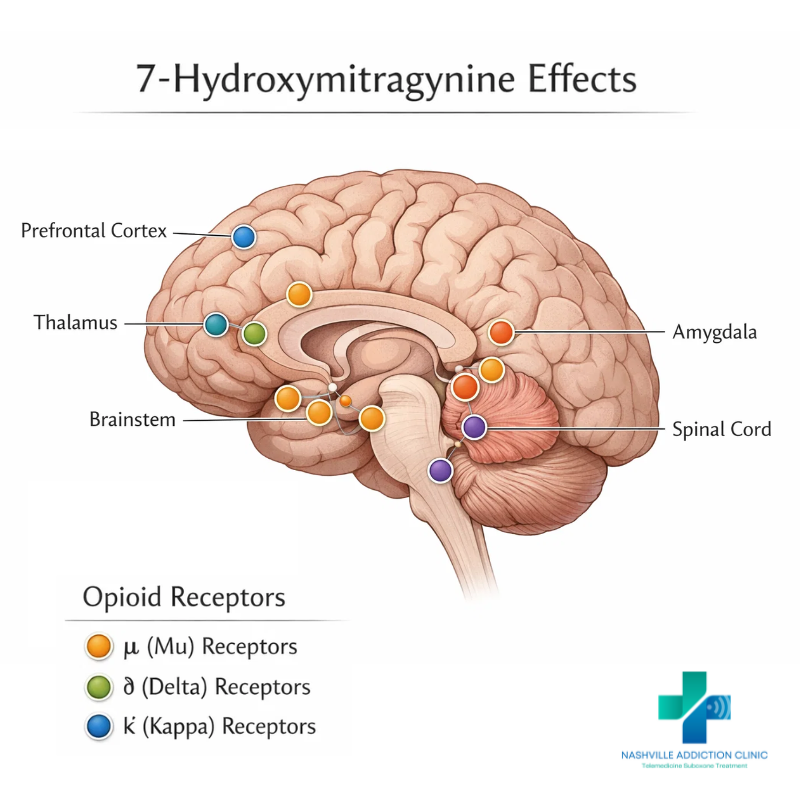
Does 7-OH/Kratom help with pain? This is a common question among people in Tennessee who are dealing with chronic pain, opioid dependence, or withdrawal symptoms. When pain interferes with work, sleep, and daily life, it’s understandable to look for relief wherever it might exist. Products containing 7-hydroxymitragynine (7-OH), a powerful compound found in kratom, are often promoted as a “natural” pain solution—but the reality is more complex and often more dangerous than advertised.
This article explains how 7-OH affects pain, the risks involved, and safer, medically proven alternatives for people seeking long-term stability and relief.
Accredited, Virtual Addiction Treatment for Tennessee
Nashville Addiction Clinic provides evidence-based Suboxone treatment through secure telemedicine, staffed by licensed Tennessee clinicians. No clinic visits required, ever.
- Statewide access across Tennessee
- Accredited by The Joint Commission
- Owned and managed by people in long-term recovery
Register for treatment online using your TennCare Medicaid, commercial insurance, or choose a payment plan. (A sliding-scale program is also available) Click here if you’re a returning patient.
What Is 7-OH/Kratom?
Kratom is derived from the leaves of Mitragyna speciosa, and 7-hydroxymitragynine (7-OH) is one of its most potent alkaloids. Unlike many herbal supplements, 7-OH interacts directly with the brain’s opioid receptors, particularly the mu-opioid receptor.
Because of this, its effects more closely resemble opioids than over-the-counter pain relievers.
Does 7-OH/Kratom Reduce Pain?
Short-Term Pain Relief
In the short term, some people report reduced pain after using kratom or 7-OH. This happens because opioid receptors temporarily block pain signals.
Common short-term effects include:
- Diminished physical discomfort
- Temporary relief from withdrawal-related aches
- Emotional numbing that reduces pain perception
However, this relief is unpredictable, short-lived, and dose-dependent.
Why Pain Often Gets Worse Over Time
With repeated use, tolerance develops quickly. As tolerance increases:
- Higher doses are needed for the same effect
- Pain sensitivity may increase (opioid-induced hyperalgesia)
- Withdrawal symptoms include body aches and muscle pain
Patients from Kingsport, Collierville, Smyrna, Spring Hill, and Gallatin often report that pain becomes worse once Kratom/7-OH dependence forms.
In other words, what often feels like a solution when first taking Kratom, often turns into dependence, just like opioid dependence occurs. Many people believe their brain used weak points such as pain and discomfort to motivate additional use—the brain tricks the person into thinking pain has escalated in order to receive more drugs.
It’s only after a person begins treatment that their pain is reduced, often well below what they believed it was while using Kratom/7-Hydroxy.
The Risks of Using 7-OH/Kratom for Pain
Using 7-hydroxymitragynine as a pain management tool carries serious risks:
- Physical dependence
- Withdrawal-related pain and flu-like symptoms
- Escalating dosage
- Mood instability and anxiety
- Difficulty stopping without medical support
- Transition to stronger opioids
The FDA and DEA warn that kratom products are unregulated, may vary widely in strength, and can contain contaminants (fda.gov, dea.gov).
“pain becomes worse once Kratom/7-OH dependence forms.”
Why People Turn to Kratom for Pain
Many people use kratom or 7-OH because they:
- Were prescribed opioids for injury or surgery
- Lost access to prescription pain medication
- Fear opioid withdrawal
- Can’t afford in-person treatment
- Live in rural or underserved areas
- Need to keep working or caring for family
These challenges are real—and they require safer, medically supervised solutions.
Is 7-OH/Kratom a Safe Long-Term Pain Solution?
No. While it may mask pain temporarily, 7-OH does not treat the underlying condition and often creates a second dependency problem. Over time, users frequently find themselves managing both pain and withdrawal.
According to SAMHSA, long-term opioid receptor stimulation—whether from prescription opioids or kratom—carries a high risk of dependence and relapse (samhsa.gov).
A Safer, Evidence-Based Option: Suboxone Treatment
For individuals whose pain is intertwined with opioid dependence, Suboxone treatment provides a more stable and safer alternative.
How Suboxone Helps With Stability
Suboxone:
- Partially activates opioid receptors.
- Though not prescribed specifically for pain in the USA, many people claim Suboxone provides pain relief
- Prevents severe withdrawal
- Reduces cravings
- Lowers overdose risk
- Stabilizes brain chemistry over time
Many patients report more consistent control once their opioid dependence is properly treated.
How Nashville Addiction Clinic Helps Patients Across Tennessee
Nashville Addiction Clinic provides 100% virtual Suboxone treatment statewide, allowing patients to get help without traveling to a physical clinic.
Treatment highlights include:
- Same-day Suboxone prescriptions
- Secure, private video appointments
- Support transitioning from kratom, 7-OH, fentanyl, heroin, oxycodone, hydrocodone, morphine, methadone, Percocet, OxyContin, kratom, 7-OH, and other opioids
- Medications sent to local pharmacies or delivered overnight
Register Today for 100% Virtual Kratom/7-Hydroxy Addiction Treatment
- Register for Suboxone Telehealth using your TennCare Medicaid
- Register for virtual Suboxone addiction treatment with your commercial insurance
- No Insurance? Register for Suboxone Telemedicine therapy and make payments
- Register as a returning patient
- Apply for our Sliding-Scale Program
- View all Medicaid and commercial insurance plans we accept and self-pay pricing
- We accept most private/employee health insurance, such as BCBS, Cigna, Ambetter, and United Healthcare, as well as all TennCare Medicaid insurance: Amerigroup Community Care, BlueCare, United Healthcare Community Plan, and Wellpoint Community Care.
- Same-day appointments and Suboxone prescriptions are often available when fully-registered before 10:00 am Central Time. (based on availability)
Not sure if your insurance is accepted? Click here to verify your coverage.
Experience a safe transition from hydrocodone, oxycodone, OxyContin, heroin, fentanyl, methadone, morphine, Kratom, 7-OH (7-Hydroxy-opioids), Tramadol, Opana, codeine, oxymorphone, Tramadol, Percocet, and other opioids.
If you would like to speak to someone about our telemedicine Suboxone program, please call or text us at (615) 927-7802. You can also message us securely on the Spruce Health mobile app.
FAQs: Does 7-OH/Kratom help with pain?
Does 7-OH/Kratom work like prescription pain medication?
It acts on similar opioid receptors but is unregulated and far less predictable.
Why does my pain feel worse when kratom wears off?
Withdrawal increases pain sensitivity and causes muscle aches and inflammation.
Can Suboxone treat pain and opioid dependence at the same time?
Many people claim Suboxone works effectively where pain and opioid dependence overlap. Suboxone is prescribed for pain throughout Europe, but not in the USA.
Will I have to stop working to start treatment?
Most patients continue working and caring for family during treatment.
Is treatment really 100% online?
Yes. Nashville Addiction Clinic provides fully virtual care statewide.
Why Choose Nashville Addiction Clinic for Kratom/7-OH/7-Hydroxy Addiction Treatment?
- Accredited by The Joint Commission
- Clinic owners are in long-term recovery
- Over 260 Google Reviews (from real patients)
- Recipient of Tennessee’s first Virtual OBOT medical license
- Same-day Suboxone prescriptions
- Statewide award winner of the 2025 Best of Tennessee award for substance abuse treatment
- Over 1000 patients served since 2019
- Accepts most commercial/employee health plans, such as Blue Cross Blue Shield (all U.S. states), Cigna, Ambetter, and United Healthcare, as well as all TennCare Medicaid plans: Amerigroup Community Care, BlueCare, United Healthcare Community Plan, and Wellpoint Community Care.
- Overnight Suboxone delivery is available in most areas (a delivery fee applies)
- A compassionate team of caring doctors, nurse practitioners, counselors, and administrators who provide judgement-free care, some who are in recovery.
- Same-day appointments available every Monday through Friday from 8:00 AM to 5:00 PM (based on availability)
- Evening appointments every Monday and Wednesday until 9:00 PM
Our helpful staff is happy to answer any questions you may have. Call us or send us a text at (615) 927-7802, or message us securely using the Spruce Health mobile app.
Feeling nervous about starting telemedicine addiction treatment? Learn what to expect during your first Suboxone telemedicine appointment.
Fast-Online Registration for Kratom Dependence
- TennCare Medicaid Kratom/7-OH/7-Hydroxy treatment
- Commercial insurance Kratom/7-OH/7-Hydroxy Addiction program
- Self-pay telemedicine Kratom/7-OH/7-Hydroxy program (make payments)
- Sliding-scale virtual Suboxone program application
You can review insurance and pricing details before scheduling, so there are no surprises.
If you have TennCare Medicaid insurance, your treatment and medication costs are typically $0. If you have commercial health insurance, we will provide you with a treatment cost estimate before scheduling your first telemedicine appointment. If you don’t have health insurance, we offer biweekly and monthly payment plans.
Related Articles
- 7-OH Addiction Treatment in Tennessee: Safe, Virtual Recovery with Suboxone
- Kratom 7-OH Recovery: Your Path to Safe, Virtual Opioid Treatment
- Is Kratom Addictive? What Tennessee Residents Need to Know
External Resources
- Kratom/7-OH/7-hydroxymitragynine addiction is another opioid addiction-related issue facing Tennessean’s, thanks to it being readily available and unregulated. Learn more about Kratom addiction and virtual treatment options in Tennessee.
- DEA.gov – Opioid Addiction Resources
- Substance Abuse and Mental Health Services Administration (SAMHSA)
- Centers for Disease Control and Prevention | CDC.gov
- National Institute on Drug Abuse
- National Center on Substance Abuse and Child Welfare
Recent Posts
- Symptoms of Kratom Withdrawal: Safe, Virtual Recovery in Tennessee
- Help for Kratom Addiction: Virtual Treatment That Works in Tennessee
- Kratom Rehab: Tennessee’s Virtual Path to Recovery
- Kratom Withdrawal Treatment in Tennessee: A Safer, Easier Path to Recovery
- Understanding Kratom Abuse and Treatment Options in Tennessee
Recent Comments