

Blog
Does Gabapentin Show Up on a Drug Test?
Understanding Gabapentin Detection, Effects, and What It Means for Recovery
If you’re asking how long does gabapentin stay in your system, you’re not alone. Many people across Tennessee—especially those dealing with opioid addiction or chronic pain—have been prescribed or used gabapentin and want clear, honest answers about how long it lasts in the body, how it’s detected, and how it interacts with recovery and treatment.
Gabapentin is not an opioid, but it does affect the central nervous system. For patients in cities like Johnson City, Bartlett, Hendersonville, Kingsport, and Collierville, understanding gabapentin’s timeline is important—especially when starting Medication-Assisted Treatment (MAT) or Suboxone through telemedicine.
Addiction Treatment for Tennessee by Tennesseans in Recovery
Nashville Addiction Clinic provides evidence-based Suboxone treatment through secure telemedicine, staffed by licensed Tennessee clinicians. No clinic visits required, ever.
- Statewide access across Tennessee
- Accredited by The Joint Commission
- Owned and managed by people in long-term recovery
Register for treatment online using your TennCare Medicaid, commercial insurance, or choose a payment plan. (A sliding-scale program is also available) Click here if you’re a returning patient.
What Is Gabapentin and Why Is It Prescribed?
Gabapentin is a prescription medication commonly used to treat:
- Nerve pain
- Seizure disorders
- Restless leg syndrome
- Off-label anxiety symptoms
- Alcohol or opioid withdrawal support (in some cases)
While gabapentin is not classified as a controlled substance at the federal level, it can cause sedation and dependence, particularly when combined with opioids or other depressants. Because of this, many providers carefully monitor its use during addiction treatment.
Is Gabapentin Included on Standard Drug Screens?
Gabapentin is not usually included automatically on a standard urine drug screen. Common screening panels typically look for selected drug classes, such as opioids, benzodiazepines, amphetamines, cocaine and cannabis.
However, there is no single definition of a “standard” drug panel. The substances included depend on the laboratory and the test ordered. Gabapentin may be included in an expanded medication-monitoring panel or ordered as a separate test. A clinician who needs to test for gabapentin must generally select a panel that specifically includes it or request a dedicated gabapentin test.
How Long Can Gabapentin Be Detected?
There is no guaranteed detection window for gabapentin. Results depend on the type of specimen, the laboratory’s testing method and cutoff, the amount and timing of the medication, repeated use and the person’s kidney function.
Urine testing: When a gabapentin-specific urine test is ordered, it can identify recent exposure. A commonly used general estimate is approximately one to three days after the last dose for someone with normal kidney function. This is only an estimate—not a dependable deadline—and detection may last longer in some people.
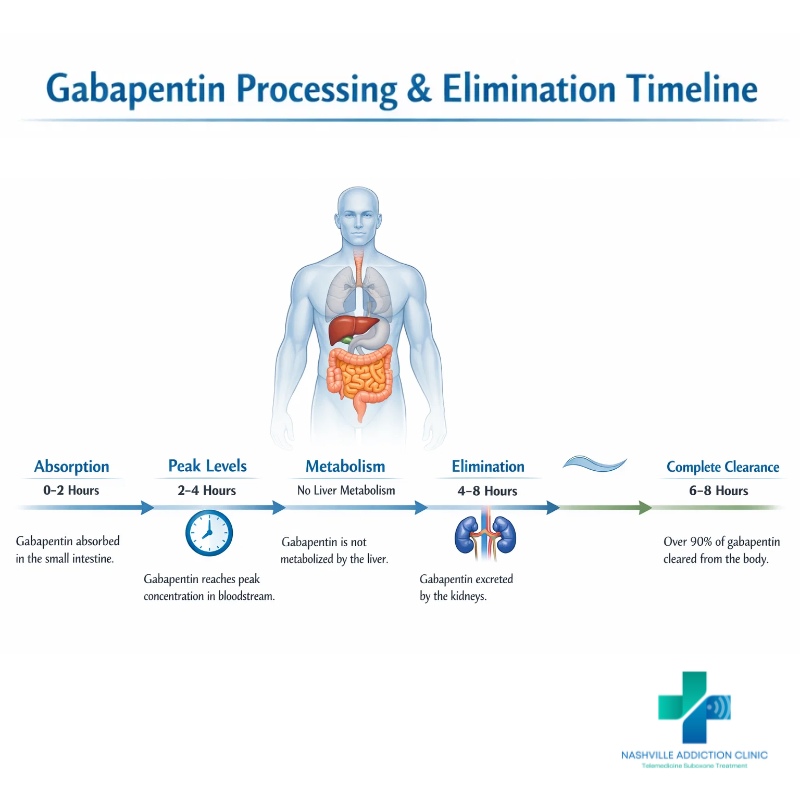
Blood or plasma testing: Gabapentin has an elimination half-life of approximately five to seven hours in adults with normal kidney function. Blood testing therefore usually reflects relatively recent exposure, but the half-life is not the same as a guaranteed detection window. The laboratory’s sensitivity and the patient’s kidney function affect how long it may be measurable.
Saliva testing: Gabapentin can be measured through specialized oral-fluid testing, but this is not a common component of routine drug screening. Authoritative medical and laboratory sources do not establish one broadly accepted saliva detection window, so specific hour-based estimates should be interpreted cautiously.
Gabapentin is eliminated primarily through the kidneys. Older age, impaired kidney function and other individual factors may cause it to remain in the body longer. A drug-test result also cannot determine the exact dose taken or prove whether a medication was used as prescribed.
Why Would a Clinician Test for Gabapentin?
A clinician may include gabapentin in medication monitoring to better understand what substances and medications are present in a patient’s system. Testing may help the treatment team:
- Compare test results with the patient’s medication list
- Monitor adherence to an individualized treatment plan
- Investigate unexpected sedation, dizziness or other safety concerns
- Identify medication combinations that may require closer monitoring
- Make more informed decisions about ongoing care
This can be especially relevant when gabapentin is taken with opioids or other medications that depress the central nervous system. These combinations may increase sedation and, in certain patients, the risk of serious breathing problems.
A positive result does not automatically indicate misuse. Clinicians interpret the result alongside the prescription history, reported medication use, symptoms, health conditions and other available information.
Do Not Stop Prescribed Gabapentin Without Medical Advice
Do not skip doses, reduce your dosage or stop taking prescribed gabapentin in an attempt to change a drug-test result. Tell your healthcare provider and the testing staff about all prescription medications you take.
Stopping gabapentin suddenly can cause withdrawal symptoms and may increase seizure risk, particularly when it is prescribed for a seizure disorder. If gabapentin needs to be reduced or discontinued, a licensed clinician should provide an individualized plan for doing so safely.
Gabapentin Half-Life Explained
Gabapentin has a half-life of approximately 5 to 7 hours. This means:
- After 5–7 hours, half of the drug is eliminated
- After about 24–48 hours, most gabapentin is cleared from the body
For most people, gabapentin is no longer active after two days, but trace amounts may linger slightly longer depending on health factors.
Factors That Affect How Long Gabapentin Stays in Your Body
Several variables influence how long gabapentin stays in your system:
- Dosage (higher doses take longer to clear)
- Frequency of use (daily vs. occasional use)
- Kidney function (gabapentin is cleared through the kidneys)
- Age and metabolism
- Body weight and hydration
- Length of time you’ve been taking it
People with reduced kidney function may retain gabapentin longer than average.
Is Gabapentin Addictive?
Gabapentin is not an opioid, but it can be habit-forming, especially when used long-term or in high doses. Some people experience:
- Tolerance (needing more for the same effect)
- Withdrawal symptoms when stopping suddenly
- Sedation or brain fog
- Increased risk when combined with opioids or alcohol
Because of these risks, medical supervision is important—especially for people recovering from opioid addiction.
Gabapentin, Opioids, and Overdose Risk
Combining gabapentin with opioids like fentanyl, heroin, oxycodone, or hydrocodone increases the risk of respiratory depression and overdose. The FDA and DEA have issued warnings about combining gabapentin with other central nervous system depressants.
Trusted sources include:
If you’re entering treatment, it’s important to disclose all medications honestly so providers can keep you safe.
What If I’m Starting Suboxone Treatment?
Gabapentin does not automatically disqualify you from starting Suboxone, but your provider will evaluate:
- Your current dose
- Why it was prescribed
- How long you’ve been taking it
- Whether tapering is appropriate
At Nashville Addiction Clinic, patients can safely transition to Suboxone from opioids such as:
- Hydrocodone
- Oxycodone
- Percocet
- OxyContin
- Morphine
- Heroin
- Fentanyl
- Methadone
- Kratom and 7-OH
Treatment is 100% virtual and available statewide.
Why Choose Nashville Addiction Clinic for Online Addiction Treatment?
- Accredited by The Joint Commission
- Clinic owners are in long-term recovery
- Over 260 Google Reviews (from real patients)
- Recipient of Tennessee’s first Virtual OBOT medical license
- Same-day Suboxone prescriptions
- Statewide award winner of the 2025 Best of Tennessee award for substance abuse treatment
- Over 1000 patients served since 2019
- Accepts most commercial/employee health plans, such as Blue Cross Blue Shield (all U.S. states), Cigna, Ambetter, and United Healthcare, as well as all TennCare Medicaid plans: Amerigroup Community Care, BlueCare, United Healthcare Community Plan, and Wellpoint Community Care.
- Overnight Suboxone delivery is available in most areas (a delivery fee applies)
- A compassionate team of caring doctors, nurse practitioners, counselors, and administrators who provide judgement-free care, some who are in recovery.
- Same-day appointments available every Monday through Friday from 8:00 AM to 5:00 PM (based on availability)
- Evening appointments every Monday and Wednesday until 9:00 PM
Our helpful staff is happy to answer any questions you may have. Call us or send us a text at (615) 927-7802, or message us securely using the Spruce Health mobile app.
Feeling nervous about starting telemedicine addiction treatment? Learn what to expect during your first Suboxone telemedicine appointment.
You can register based on your coverage:
- Register for Suboxone Telehealth using your TennCare Medicaid
- Register for virtual Suboxone addiction treatment with your commercial insurance
- No Insurance? Register for Suboxone Telemedicine therapy and make payments
- Register as a returning patient
- Apply for our Sliding-Scale Program
- View all Medicaid and commercial insurance plans we accept and self-pay pricing
- We accept most private/employee health insurance, such as BCBS, Cigna, Ambetter, and United Healthcare, as well as all TennCare Medicaid insurance: Amerigroup Community Care, BlueCare, United Healthcare Community Plan, and Wellpoint Community Care.
Not sure if your insurance is accepted? Click here to verify your coverage.
Experience a safe transition from hydrocodone, oxycodone, OxyContin, heroin, fentanyl, methadone, morphine, Kratom, 7-OH (7-Hydroxy-opioids), Tramadol, Opana, codeine, oxymorphone, Tramadol, Percocet, and other opioids.
If you would like to speak to someone about our telemedicine Suboxone program, please call or text us at (615) 927-7802. You can also message us securely on the Spruce Health mobile app.
Why Medical Supervision Matters
Stopping gabapentin suddenly can cause symptoms such as:
- Anxiety or agitation
- Insomnia
- Nausea
- Sweating
- Increased pain
Medical providers can guide safe tapering and ensure medications don’t interfere with recovery goals.
Nashville Addiction Clinic has over six years of experience treating opioid addiction in Tennessee and has helped more than 1,000 patients through compassionate, stigma-free care.
Learn more about insurance and pricing.
FAQs About Gabapentin
Can gabapentin cause withdrawal?
Yes, especially after long-term use. Withdrawal is usually mild but should be managed medically.
Will gabapentin show up on a probation drug test?
Usually no, unless the test specifically includes gabapentin.
Can I take gabapentin while on Suboxone?
Sometimes, but only under medical supervision due to increased sedation risk.
How long until gabapentin is fully out of my system?
For most people, within 48 hours—longer if kidney function is impaired.
Is gabapentin safer than opioids?
It carries fewer risks than opioids, but misuse can still be dangerous.
Clear Answers Support Safer Recovery
Understanding how long gabapentin stays in your system helps you make safer, more informed decisions—especially when starting addiction treatment. With the right medical guidance, recovery can begin without fear, confusion, or unnecessary risk.
Fast-Online Registration for Same-Day Suboxone Prescriptions
- TennCare Medicaid virtual addiction treatment coverage
- Commercial insurance Suboxone telemedicine program
- Self-pay telemedicine Suboxone program (make payments)
- Sliding-scale virtual Suboxone program application
You can review insurance and pricing details before scheduling, so there are no surprises.
If you have TennCare Medicaid insurance, your treatment and medication costs are typically $0. If you have commercial health insurance, we will provide you with a treatment cost estimate before scheduling your first telemedicine appointment. If you don’t have health insurance, we offer biweekly and monthly payment plans.
Related Articles
- Will Suboxone Show Up on a Drug Test?
- Suboxone Dr Near Me: Your Guide to Opioid Addiction Treatment
- Purchase a 12-Panel POC Drug Screen Cup from Amazon for $5 (with free shipping)
External Resources
- Kratom/7-OH/7-hydroxymitragynine addiction is another opioid addiction-related issue facing Tennessean’s, thanks to it being readily available and unregulated. Learn more about Kratom addiction and virtual treatment options in Tennessee.
- DEA.gov – Opioid Addiction Resources
- Substance Abuse and Mental Health Services Administration (SAMHSA)
- Centers for Disease Control and Prevention | CDC.gov
- National Institute on Drug Abuse
- National Center on Substance Abuse and Child Welfare
Recent Posts
- Online Fentanyl Addiction Treatment for Tennessee Residents
- UnitedHealthcare Medicare Advantage Accepted at Nashville Addiction Clinic
- She Took Kratom for One Week — and Ended Up on Life Support: What Her Story Means for Tennessee
- Symptoms of Kratom Withdrawal: Safe, Virtual Recovery in Tennessee
- Help for Kratom Addiction: Virtual Treatment That Works in Tennessee
Recent Comments